Brain Training and Cognitive Function Evidence: Does It Really Work?
Nearly 10 million new cases of dementia are diagnosed worldwide every single
year, a number that has pushed researchers and everyday readers alike to ask
hard questions about brain training and cognitive function evidence. We
built this guide to walk through what the current research actually shows,
which habits and compounds have real data behind them, and where the hype
outpaces the science.
Key Takeaways
-
Cognitive training works best as part of a bigger picture.
The strongest brain training and cognitive function evidence comes from
studies that combine mental exercises with sleep, exercise, and diet,
not from apps used in isolation.
-
Processing speed training shows the biggest dementia-risk
reduction
of any single cognitive training method studied in long-term trials.
-
Herbal nootropics like Bacopa monnieri and Lion's Mane
have clinical data supporting memory and cognitive support, though
results take weeks, not days. See our
Bacopa memory enhancement research
for the full breakdown.
-
Sleep acts as a biological filter for the brain,
clearing out proteins linked to cognitive decline, according to our
evidence-based cognitive decline prevention strategies.
-
Dosage matters as much as the ingredient itself. Our
complete nootropic dosage guide
outlines how to start low and adjust safely.
-
Caffeine paired with L-theanine is one of the most
consistently reproduced combinations for calm, sustained focus, detailed
in our
caffeine and L-theanine stack guide.
-
Not sure where to start? Our stack finder quiz matches
your goals to an evidence-informed routine.
What Does Brain Training and Cognitive Function Evidence Actually Show?
The phrase "brain training" covers everything from puzzle apps to structured
cognitive drills used in clinical trials. Not all of it holds up equally
under scrutiny.
What separates the credible research from marketing claims is duration,
sample size, and whether gains transfer to real-world function rather than
just improving scores on the training task itself. Longitudinal studies
tracking thousands of participants over a decade give us the clearest brain
training and cognitive function evidence available today.
In a 10-year study of 2,802 healthy older adults, processing speed
training cut dementia risk with a hazard ratio of 0.71 compared to
untrained controls, according to Nature Scientific Reports.
That hazard ratio means participants who trained on processing speed tasks
were substantially less likely to develop dementia over the following
decade. It is one of the strongest single data points we have for structured
cognitive training as a genuine risk-reduction tool.
Cognitive Training and Brain Health Habits: The Foundation of the Evidence
Cognitive training rarely works alone. Our
brain health lifestyle habits guide
outlines nine science-based habits, and mental stimulation is only one
piece.
Sleep plays a role that many people underestimate. During deep sleep, the
glymphatic system clears neurotoxic proteins from the brain, a process our
cognitive decline prevention resource
describes as a biological filter.
Exercise, social engagement, and diet round out the framework. A large
portion of dementia risk is considered modifiable through these lifestyle
factors, which is why brain training and cognitive function evidence
increasingly points toward combined interventions rather than a single magic
bullet.
The POINTER Trial: Structured Lifestyle Intervention Data
The US POINTER trial followed 2,111 older adults through a structured
program combining cognitive training with physical activity, diet, and
social interaction. The results add real weight to the brain training and
cognitive function evidence base.
Participants following the structured, higher-intensity protocol saw
meaningfully greater cognitive gains than those in a self-guided version of
the same program, according to data published by NATAP.
The takeaway is simple. Structure and consistency matter more than the
specific app or tool you choose.
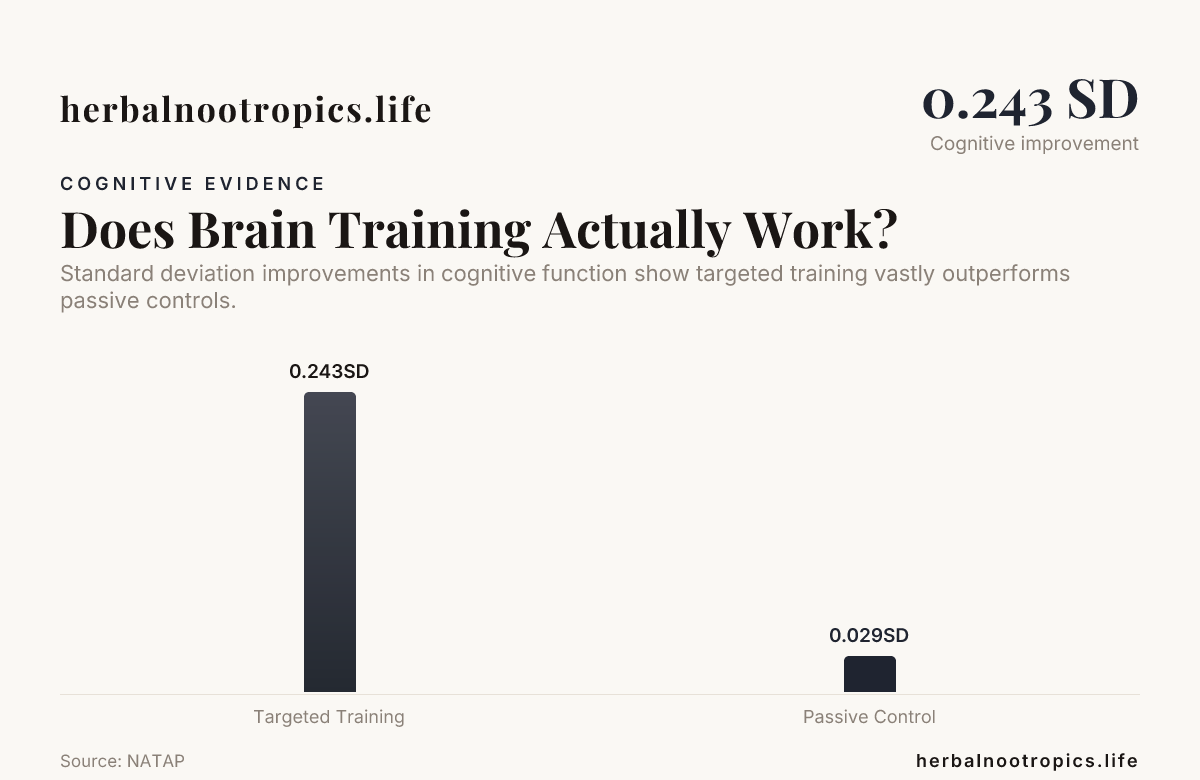
Standard deviation improvements in cognitive function show targeted
training vastly outperforms passive controls.
Bacopa Monnieri: The Leading Memory Enhancement Evidence
Among herbal nootropics, Bacopa monnieri has the deepest research base for
memory support. Clinical trials consistently show measurable improvements
after 8 to 12 weeks of daily use, not overnight.
Typical dosing runs 300 to 450 mg per day of an extract standardized to
24-55% bacosides. We cover the full protocol, including timing and what to
expect week by week, in our
Bacopa memory enhancement research page
and our companion
Bacopa for memory guide.
This slow-and-steady timeline is a common thread in brain training and
cognitive function evidence generally. Compounds and training programs that
show durable results almost always require weeks of consistent use before
benefits appear.
Lion's Mane and NGF: What the Clinical Data Shows
Lion's Mane mushroom has drawn attention for its potential to stimulate
nerve growth factor (NGF), a protein involved in neuron maintenance and
repair. Studies in adults with mild cognitive impairment show improvements
over several weeks of supplementation.
Our
Lion's Mane benefits for brain health guide
covers the clinical context, recommended timing, and how NGF stimulation
fits into the broader neuroprotective picture. It pairs well with the
mushroom-focused research summarized in our nootropic mushrooms scientific
evidence review.
Supplements for Memory and Brain Function: A Wider Evidence Review
Beyond Bacopa and Lion's Mane, several nutrients and compounds carry
meaningful support in the research literature. Citicoline, omega-3 fatty
acids, and foundational vitamins and minerals all show up repeatedly in
cognitive function studies.
Our
supplements for memory and brain function guide
lays out dosing ranges and safety notes for each, organized so you can
compare options side by side.
|
Ingredient
|
Primary Evidence
|
Typical Timeline
|
| Bacopa monnieri |
Memory consolidation in clinical trials
|
8-12 weeks |
| Lion's Mane |
NGF stimulation, mild impairment studies
|
Several weeks |
|
Caffeine + L-Theanine
|
Calm focus, reduced jitters
|
Immediate, per dose
|
| Citicoline |
Attention and processing support
|
Weeks to months |
Caffeine and L-Theanine: Fast-Acting Brain Training Support
Not every piece of cognitive function evidence requires weeks of patience.
The caffeine and L-theanine stack is one of the most reliable combinations
for immediate, noticeable focus.
A standard protocol uses 100 mg caffeine with 200 mg L-theanine, a 2:1 ratio
designed to smooth out caffeine jitters while preserving alertness. Our full
caffeine and L-theanine stack guide
breaks down why this pairing works and how to time it around study or work
sessions.
Getting the Dosage Right: Why Evidence-Based Dosing Matters
Even the best-researched ingredient will disappoint if the dose is wrong.
This is a part of brain training and cognitive function evidence that gets
overlooked far too often.
The golden rule researchers and clinicians repeat is to start low and go
slow. Gradual escalation from the minimum effective dose helps prevent
adverse effects and lets you track your own response accurately.
Our
complete nootropic dosage guide for beginners
lays out starting doses and a structured progression for the most common
compounds.
Study Stacks: Applying Cognitive Function Evidence to Exam Prep
Students and professionals often want a practical application of all this
research rather than an abstract summary. A study stack combines
memory-supporting compounds with acute focus enhancers for a specific window
of time.
Our
study stack nootropic guide
outlines a memory foundation protocol for long-term retention alongside
acute focus strategies for the day of an exam or big presentation, along
with safety considerations for combining compounds.
In the US POINTER trial of 2,111 older adults, a structured lifestyle
intervention including brain training produced a global cognitive
composite score increase of 0.243 standard deviations per year, according
to NATAP.
Natural Nootropics: Where Herbal Options Fit Into the Evidence
Beyond single ingredients, a wider category of natural nootropics offers a
gentler on-ramp for people wary of synthetic compounds. Bacopa, Lion's Mane,
and Rhodiola all appear frequently in this space, alongside premium
formulated blends.
Our
natural nootropics guide
gives UK-specific guidance on sourcing, dosing, and legality, which matters
given how regulation varies by ingredient and region.
Legal and Safety Considerations in the UK
Before starting any regimen, it helps to understand what is actually legal
to buy and use. Our
UK nootropics legal guide
covers the current regulatory landscape as of 2026.
For anyone new to the category, we also recommend starting with our
safe beginner nootropic stack for the UK, which pairs well-tolerated ingredients at conservative doses.
Finding the Right Approach for Focus and Memory Goals
Not everyone is chasing the same outcome. Some readers want sharper focus
for work deadlines, while others are more concerned with long-term memory
preservation.
Our
best nootropic for focus guide
and dedicated memory support resources separate these two goals so you are
not applying focus-oriented advice to a memory problem, or vice versa. If
you would rather skip the reading and get a direct recommendation, our
stack finder quiz
takes your goals and matches them to an evidence-based starting point.
Conclusion
The honest answer to "does brain training work" is nuanced. Brain training
and cognitive function evidence supports structured, consistent training
combined with sleep, exercise, and select herbal nootropics, but it does not
support the idea that a single app or supplement will dramatically rewire
your brain overnight.
The research we have reviewed here, from decade-long dementia studies to
eight-week Bacopa trials, points toward the same conclusion: consistency and
realistic timelines matter more than any single product. Start with our
nootropic products overview
if you want to explore evidence-backed options for your own routine.
Frequently Asked Questions
Does brain training actually improve cognitive function?
Yes, according to long-term studies, structured cognitive training,
particularly processing speed training, is linked to measurable
reductions in dementia risk over a decade. The strongest brain
training and cognitive function evidence comes from programs combining
mental exercises with lifestyle changes rather than standalone apps.
How long does it take to see results from brain training or nootropics?
Most credible evidence shows gains appearing after weeks to months of
consistent effort, not days. Bacopa monnieri, for example, typically
takes 8 to 12 weeks to show measurable memory improvements in clinical
trials.
Are brain training apps worth it in 2026?
Memory-focused applications hold roughly 28.1% of the brain training
app market in 2026, showing continued consumer interest, but results
vary based on how consistently and correctly they are used. They work
best as one part of a broader routine that includes sleep, exercise,
and possibly evidence-based supplements.
What supplements have the best cognitive function evidence?
Bacopa monnieri and Lion's Mane currently have the most robust
clinical support among herbal nootropics for memory and cognitive
support. Citicoline and omega-3 fatty acids also show consistent
benefits in the wider research literature.
Can caffeine and L-theanine really improve focus?
Yes, the combination is one of the more reliably reproduced findings
in cognitive research. A 2:1 ratio, typically 100 mg caffeine to 200
mg L-theanine, is associated with calmer, more sustained focus than
caffeine alone.
Is it safe to combine multiple nootropics in a stack?
It can be, provided you follow a start-low, go-slow dosing approach
and understand each ingredient individually first. Our nootropic
dosage guide and study stack guide both cover safety considerations
for combining compounds responsibly.
What is the single most effective brain training method according to
research?
Processing speed training currently has the strongest single data
point, showing a hazard ratio of 0.71 for dementia risk reduction over
a 10-year study period. That said, the overall body of brain training
and cognitive function evidence favors combined approaches over any
one isolated method.